How Strike Price Affects Options Premium: Explained with Examples
Introduction
One of the most important pricing factors in options trading is the strike price. It plays a major role in determining how much you’ll pay (or receive) for an options contract. In this guide, we’ll explain how the strike price affects the options premium, and what it means for your trading strategy.
What Is an Options Premium?
The options premium is the price you pay to buy an option (or receive when selling one). It consists of two components:
- Intrinsic Value – The built-in profit if exercised today
- Time Value – Based on time until expiry, volatility, and demand
How Strike Price Influences Premiums
1. Call Options
- Lower strike prices (closer to or below current price) have higher premiums
- Higher strike prices (OTM) have lower premiums
2. Put Options
- Higher strike prices (above market price) cost more
- Lower strike prices are cheaper
This is because the likelihood of the option finishing in-the-money decreases the further it is from the current market price.
Real Example: Apple (AAPL) Stock at $180
| Type | Strike Price | Premium (Est.) | Option Status |
|---|---|---|---|
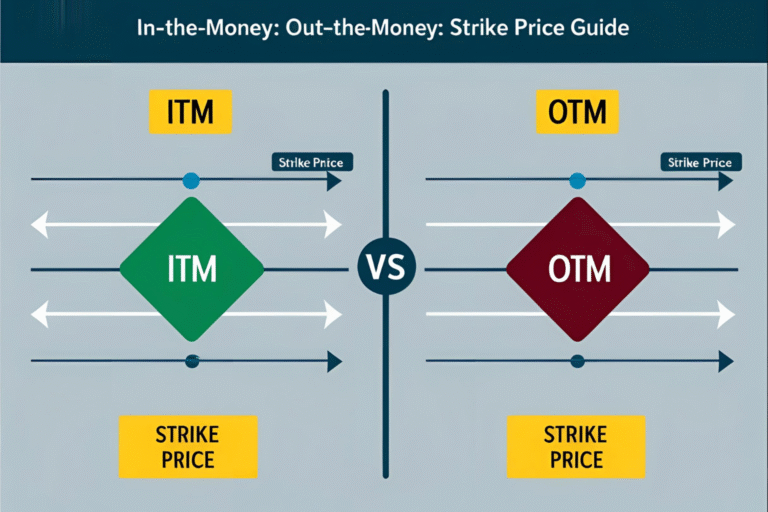
| Call | $170 | $13.00 | In-the-Money |
| Call | $180 | $7.50 | At-the-Money |
| Call | $190 | $2.80 | Out-of-the-Money |
| Put | $190 | $11.50 | In-the-Money |
| Put | $180 | $6.20 | At-the-Money |
| Put | $170 | $2.40 | Out-of-the-Money |
You’ll notice that the premium drops as the strike price gets further from the current market price.
Why This Matters for Traders
- Higher premiums mean higher breakeven prices.
- Lower premiums reduce cost but lower probability of success.
- You must weigh cost vs. reward when selecting strike prices.
Tips for Using Strike Price in Premium Strategy
- For safer trades, consider ITM or ATM even if the premium is higher.
- Use OTM strikes only when expecting significant price movement.
- Always check the break-even price:
- Call = Strike + Premium
- Put = Strike – Premium
Conclusion
The strike price plays a central role in how much an option will cost. Lower strike prices for calls and higher strike prices for puts generally mean higher premiums. Understanding this dynamic helps you make smarter, risk-managed trades.
FAQs
Q1. Why do some strike prices have higher premiums than others?
Because they offer a higher chance of finishing in-the-money or already have intrinsic value.
Q2. Do OTM options always have low premiums?
Yes, but that’s because they have no intrinsic value—just time value.
Q3. Can strike price affect both call and put premiums?
Absolutely. It’s one of the key inputs in options pricing for both types.
Q4. Should I always choose the cheapest premium?
Not necessarily—cheaper options have lower probabilities of profit.
Q5. What’s the relationship between strike price and risk?
Typically, the further from the market price the strike is, the riskier (and cheaper) the option.